Choice of the most efficient jurisdiction in the field of air accidents (Fr)

INTRODUCTION

Technical progress in the transport sector is increasing, at the same time, litigation in the area of air law is evolving.

Faced with this development, the law is intended to govern this mode of transport.

The opposition lies in the fact that the law is national, internal, while aviation has a
international vocation, which poses the problem of conflicts of laws as well as of all
air carrier liability matters.

The last air disaster of July 25, 2000, that of the Concorde, is an illustration
tragic of what technical progress and the evolution of this litigation can represent.

With regard to the Concorde case, there is the problem of knowing which courts will
be competent, the interest being that the amount of compensation may vary from country to country
the other.

The lawyers for the beneficiaries of the victims therefore wish to obtain sums
close to the damages obtained by accident victims in the United States,
generally much higher than those paid in the rest of the world.

The evolution of the damage therefore varies depending on the jurisdiction and applicable law.

Thus, in the case of the Concorde accident, according to article 28 of the Warsaw Convention
of 1929, four jurisdictions can be seized: that of the place of departure of the plane, that of
place of destination, that of the place of issue of the ticket and that of the place of residence of the
carrier.

The New Montreal Convention of 1999 establishes the place of domicile of the victims as competent courts.

The cost of the Concorde accident, meanwhile, could reach $ 350 million,
according to an expert from the New York-based Insurance Information Institute. (The World 27
July 2000).

We can thus see that the consequences of the choice to found this or that competence is significant,
taking into account the financial stakes involved in compensating victims.

Conversely, for air accidents that would have occurred in a Third World country,
the compensation would not be the same, (on January 30, 2000, the flight of Kenya Airways which
was on the Abidjan - Lagos - Nairobi link crashed shortly after takeoff from
Abidjan Airport), and the maximum amount offered by the airline is
20,000 $ of damages.

Talking about the liability regime for air transport naturally implies
to speak of the Warsaw Convention of October 12, 1929, and to recall its principles, both
with regard to the applicable rules of jurisdiction than with regard to the
responsibility for evidence.

I- RULES APPLICABLE IN MATTER OF AIR LAW UNDER THE WARSAW CONVENTION:

A. RULES OF JURISDICTION

The concept of international air transport is defined in Article 1 of the Convention
Warsaw. The Warsaw Convention allows in its article 28 that the action in responsibility
be worn, at the request of the applicant, only in pre-established places, namely:
- The court of the carrier's domicile

- The main headquarters of its operation
- The place where he has an establishment by the care of which the transport contract was established
- The Court of the place of destination

This action must be brought under penalty of forfeiture, within two years from
of arrival at destination, or of the day on which the aircraft should have arrived, or of the transport stop
(Article 29).

B. REGIME OF LIABILITY

The Warsaw Convention likewise lays down the principles of responsibility, namely that the
air carrier is presumed responsible (article 17) for the damage, "in the event of
death, injury or other bodily harm suffered by a traveler, when
the accident which caused damage occurred on board the aircraft, or during any
embarkation or disembarkation operation ”.

Therefore, to trigger the presumption of liability of the carrier, the victim or his
beneficiaries will simply have to prove that they suffered damage (following an accident),
and that it occurred on board the aircraft during boarding or
landing.

The carrier will not be able to escape the presumption of responsibility except the fault of the injured party (article 21), unless he proves that he and his employees have taken all the necessary measures to avoid the damage, or that he they could not take them (article 20).

C. CONCEPT OF INEXCUSABLE FAULT AND AMOUNT OF REPAIR

The limits for compensation in the event of accidental death or injury to passengers currently provided for by the Warsaw Convention are 125,000 gold francs per person (approximately 10,000 $ US or 62,000 FF).

However, by a special agreement with the carrier, the passenger may set a limit
higher liability (Article 22.1). This limit was raised to 250,000 gold francs
(approximately 20,000 $ US or 124,000 FF) by the Additional Protocol to the Convention
Warsaw, known as the "Hague Protocol" (entered into force August 1, 1963).

Likewise, the ceiling under the Warsaw Convention may be exceeded,
thus allowing the victim to obtain full reparation for his damage.

This faculty results from article 25 of the Warsaw Convention which specifies that if a fault
inexcusable (the inexcusable fault having been interpreted by the case law as a fault
objective) can be blamed on the carrier or his agents (acting in the exercise of
their functions), the limits of liability in article 22 do not apply.

Faced with the impossibility of reaching an international agreement, many States have,
for domestic air transport, increased these ceilings. This is for example the case of the
France which established the liability limit at 750,000 FF (article L 322-3 of the Code of
civil aviation), or that of the United States and Japan which do not provide for any
limitation of liability.

II- RULES APPLICABLE IN MATTER OF AIR LAW UNDER THE MONTREAL CONVENTION:

The Council of the International Civil Aviation Organization met in Montreal in
1999, to prepare a new Convention, to replace the Warsaw Convention
from 1929.

The objective of the new convention is not only to abandon the 1929 convention,
but also to present a new set of rules governing the liability of the
air carrier.

A. NEW JURISDICTIONAL PROVISIONS

Among the new features of the new Montreal convention is the enlargement of the four
Article 28 jurisdictions of the Warsaw Convention.

Indeed, it introduces a new jurisdiction which is that of the place where the passenger has his
principal or permanent residence, if the carrier operates directly or through
through a commercial partner in the jurisdiction of this jurisdiction.

Thus, Article 33 of the new Convention provides: "With regard to damage
resulting from the death or bodily injury suffered by a passenger, the action in

liability may be brought… in the territory of a State Party where the passenger has his
principal and permanent residence at the time of the accident and to or from which
the carrier operates air transport services… ”

The main and permanent residence designating the single fixed and permanent place of stay of the
passenger at the time of the accident. The nationality of the passenger is not by the factor
decisive in this regard.

However, this fifth skill is optional and is only applicable under three
cumulative conditions of residence, operation and presence.

B. NEW LIABILITY PROVISIONS

The concept of liability for risk or objective was also introduced ("strict
liability ”), for accidents, within the meaning of article 17. Under the scheme adopted, the complainant is
sure to obtain, within the limit indicated, compensation for the damage he will have suffered, since the
carrier can not invoke heads of exemption except the fault of the victim (article
20).

If he wishes an additional repair, he will have to confront the transporter, who may
then, to prove the fact that the damage does not result from its negligence (article 21-2-a). Furthermore,
action for damages can only be brought under the conditions and within the limits of
liability under the Convention.

These various provisions reaffirm the principle of the exclusivity of the Convention of
Warsaw for all repair requests associated with the Transport Contract, a
times when the courts sometimes tend to want to apply national law.

We are therefore witnessing an evolution of litigation in the area of air law, litigation which
deals on an international basis. At the same time, there is a unification of the law of
transport, materialized by the birth of a new agreement, the
Montreal, intended to provide solutions to this same dispute.


The evolution of arbitration laws in francophone Africa (En)

by Dr. Roland Amoussou-Guenou (Lawyer at the Paris Bar, Assistant Secretary of the Pan-African Council of the LCIA).
An Advisory Paper Presented by the International Law Firm SCP Weissberg

This paper was prepared for the Conference on the Arbitration of International Trade and
Investment Disputes in Africa held in Johannesburg, South Africa from 5-7 March 1997.

INTRODUCTION

A lot of preconceived ideas have been propagated concerning arbitration in Africa. Indeed, for
many practitioners and arbitrators from Western Countries, arbitration in this continent is
more or less, terra incognita.

It is true that while arbitration was developing and expanding fast all over the world, Africa
was being left behind in this race. In addition, the notable dearth of literature on arbitration in
this area cannot be denied (1).

Currently, significant steps are being taken regarding the laws and practice of arbitration in
Africa. On this basis, one must certainly admit that now the time is ripe for arbitration to
expand in this part of the world.

The purpose of this paper is to present the evolution of the arbitration laws and practices in
francophone Africa since anglophone Africa has already been very well covered (2).

African laws relating to arbitration included two main sets of rules. The first relates to the
general rules of law and the second to investment law. Both have domestic and international
sources.

Investment law contains a whole range of legal guarantees intended to attract investments. Included among these legal guarantees is arbitration. Thus "arbitration under the general rules of law" means arbitration not involving matters of investment law (3), which is itself an important but different issue that will not be considered here.

In order to locate ourselves within the evolution of arbitration under the "general rules of law"
in francophone Africa, it may be useful to consider the early sixties as the focal point.

The early sixties coincided with the accession to political independence of most of Africa's
sub- Saharan states. This time is also considered as the starting point of expansion of
international commercial arbitration (4).

I - The past: the background of francophone Africa's legal systems with regards to the
"Process of legislative extension"

This rule is particular to the French colonial system. It is established by the principle of
"Legislative specialty" (a), which needs to be illustrated here with some examples (b). After
which we will see that some of the difficulties with which francophone African countries have
been confronted to date, especially in the matter of arbitration legislation, originate from that
principle (c).

a) The definition of the principle "legislative specialty"

The principle of "legislative specialty" has a history that goes back a long way. Following
the Revolution of 1789, the French authorities established that "the status of the colonies are
determined by special orders ”(5).

From this time onwards, the laws applicable in France's overseas territories were those
enacted in the Metropole and extended to these territories by a special enactment of the
colonial legislator (6).

b) The application of the principle of "legislative specialty" in the matter of arbitration: some examples.

The impact of this principle in the matter of arbitration, can be examined in the light of the
Civil Procedure (i), the Commercial Law (ii) and the Administrative Law (iii).

i) The Civil Procedure

As far as arbitration was concerned, although the French Code of Civil Procedure was
extended to francophone Africa (7), surprisingly, the provisions related to arbitration in this
Code were not applicable.

This contrasts with the English African colonies, where the Arbitration Act of England was
deemed applicable (8). The example of Kenya is a good illustration of the difference between
the legal policies of the French and English colonial authorities.

As pointed out by Mr. Justice Coudrey OBE (9), the Order in Council of 1897 which established the Protectorate of Kenya provided that the Common Law, Doctrines of Equity, and Statutes of General Application in force in England on the 12th August 1897 should apply in Kenya (meant that from the beginning, The Arbitration Act of 1889 applied in this country).

This raises the important issue of why the French colonial authorities did not extend the
arbitration legislation to their colonies? Of course such a question is not easy to answer. One
acceptable hypothesis is that during the nineteenth century, arbitration as a judicial means of
settlement of disputes on the legal basis of the parties's agreement, did not fit in with the
French colonial policy known as "direct rule", as opposed to the "indirect rule" of the English
colonial system (10)

The French authorities were more dictatorial in administrating their territories. Their
preoccupation at that time was to keep tight control on the resolution of disputes in their
territories (11).

The lower judicial power was delegated to the indigenous authorities but at the same time,
any powers of arbitration which might interfere with the judicial organization mentioned
above were removed from the potential users of the Code of Civil Procedure (12).

Therefore, the absence of law concerning arbitration within the legal system of the French
colonies soon after independence originates from this French colonial policy.

ii) The Commercial Law

The French Code of Commerce was extended to the former French territories of Western
(FWA) in 1907 and Equatorial Africa (FEA) in 1910 13. Also applicable to the former
territories was the law of 31st December 1925 which completed the provisions of the Code of
Commerce and declares arbitration agreement valid in commercial matters (14).

It is noteworthy that this law of December 31st 1925, was enacted after the Geneva
Convention of 1923 on arbitration agreement (15), to which France was party in the context
of what may be considered as a certain "openness" to arbitration. This "openness", benefited
the French colonies because this law was declared applicable to them.

But paradoxically, this extension of the law of 31st December 1925 created an abnormal
situation in the legal sphere in that it produced the existence of a law admitting the validity of
arbitration agreements in commercial matters on the one hand, while on the other hand, the
rules of procedure enabling the arbitration process to work were absent.

iii) The Administrative Law

The Administrative Law represents one important particular of the French legal system
compared to the English Common Law. The French Administrative Law's prohibition of
arbitration as a means of settlement of disputes for administrative bodies was extended to the
colonies.

To the best of our knowledge, the only exception concerns Burkina Faso (ex Upper Volta),
where a law of 17th April 1906 authorizes arbitration for settlement of disputes in the matter
of public delivery or construction (16).

c) The limitations of "legislative specialty" with regards to the difficulties raised
The legislation in the Metropole was not extended systematically to all the territories.

Furthermore, when it occurred (which was not always the case as in the matter of arbitration
in the Code of Civil Procedure), the extension of the French law in the colonies, was only
effective from a precise date, sometimes after the original legislation was enacted. Thesis
extensions became the starting point of the evolution of the African legal system.

Any modification made in the law of the Metropole was only extended to the African law if
the modification was anticipated, which was rarely the case. This is the reason why African
countries lived, and are still living in a state of law that is out of date in the "exporting
country ”.

This situation added to the above mentioned legal vacuum in arbitration, results in a damaging
legal insecurity for business and trade transactions, which African judges and legislators are
trying to deal with.

II- The Present: current situation of arbitration laws in francophone Africa

The current state of arbitration of "general nature" (as opposed to arbitration of "investment
nature ”) concerns two main sources, domestic (a) and international (b).

a) Domestic sources of arbitration

Following independence in the 1960's, the majority of the new francophone African states
kept the status quo of their legal inheritance. As a result, no arbitration laws exist in their legal
systems to date (i). On the other hand, among the new African states which filled the vacuum
concerning arbitration legislation, some enacted laws related to domestic arbitration (ii) while
very few of them have promulgated laws on domestic and international arbitration (iii). In all
cases, arbitration laws in force in francophone Africa whether domestic or international, show
that "the basic connection with the parent legal system remains" (17).

(i) African states with no arbitration laws

These are Benin (18), Burkina Faso, Central African Republic, Gabon, Guinea, Mali,
Mauritania and Niger (19). The former French law on arbitration not having been extended
to these countries, means that there is a total legislative vacuum.

However, as already mentioned above, the Law of December 31st 1925 which authorizes
arbitration clauses in commercial matters is applicable.

(ii) African states with domestic arbitration laws

Contrary to what happened in the countries where the status quo was maintained, soon after
their independence, many French speaking countries enacted legislation related to domestic
arbitration. It would be interesting to review the situation in some of the countries concerned.

- Cameroon

The legal system of this country is influenced both by the French and the English law (20). Arbitration is governed by articles of the Code of Civil and Commercial Procedure (21) which are very close to the former French law on arbitration. It is to be noted that the previously mentioned law of 31st March 1925 is also applicable in Cameroon.

- Congo

The Code of Civil, Commercial, Administrative and Financial Procedure (22) of Congo
includes only one article governing arbitration. Indeed, under article 310 paragraph 2 of said
Code, a foreign award can be granted exequatur and enforced in Congo although the
arbitration agreement and the arbitral proceedings are not regulated.

One can deduce that there is a tacit acceptance of the arbitration agreement in the Congolese
law. Although it seems that Congo is not yet party to the New York Convention on recognition
and enforcement of foreign awards, one can conclude that the solution adopted by the
Congolese legislator is concise and effective as they have not thought it necessary to enact
other provisions to enable international arbitration.

The international validity of the arbitration agreement, derived from the well established
general legal principles of separability and competence-competence on the one hand, and the
domestic recognition of the foreign award on the other hand, seem sufficient to make
arbitration effective in the Congolese legal system.

- Senegal

This country was one of the most important territories in the French colonial policy in Sub-Saharan Africa (23). Arbitration is currently regulated in Senegal, in the Code of Civil Procedure promulgated in 1964 (24). These provisions are quite similar to those of Cameroon and therefore, to the former Code of Civil Procedure of France. The law of December 31st 1925 is still applicable in Senegal.

However a new arbitration bill has already been drafted and submitted to the legislative
authorities. This law will probably be enacted in 1998.

- Chad

In this country, arbitration is governed by Ordinance of 28th July 1967, related to the Code of Civil Procedure (25). It is influenced by former French arbitration rules, like the other former French colonies. One should bear in mind that the law of 31st December 1925 is also applicable there.

- Democratic Republic of Congo (Ex - Zaire)

Although it is a francophone country, the Democratic Republic of Congo (Ex Zaire), is not a typical French colony. This country was a former colony of Belgium, which is also a French speaking country. Arbitration is regulated in The Democratic Republic of Congo (26) by articles 159 to 194 of the judicial Code of 1960 (27).

(iii) African States with international arbitration laws

To date, only three countries are concerned: Djibouti, Ivory Coast and Togo (28).

- Djibouti

The Djiboutian Code of International Commercial arbitration which was the very first African legislation on the matter of international arbitration was enacted in 1984 (29).

It is influenced by the French decree of May 12th 1981 on international arbitration. Tea
definition of international commercial arbitration and the arbitral proceedings are organized
on the same legal basis. It is also in accordance with the modern instruments on international
arbitration such as the Geneva Convention of 1961 and the United Nation Commission for

International Trade Law (UNCITRAL) Model Law. It is important to note that The Federation
of the Chambers of Commerce of the member states of the Preferential Trade Area for
Eastern and Southern African States ("PTA") (30) decided in 1987 to create a Regional
Arbitration Center based in Djibouti. As a result, the Djiboutian Code may be of considerable
importance for arbitration in the region during the coming years.

- Ivory Coast

The Code of Civil, Commercial and Administrative Procedure of Ivory Coast of 1972 (31) does not regulate arbitration. Thus, when the tribunals of this country were to decide on the issue of the validity of the arbitration agreement, during the late eighties, they faced a serious obstacle. In the presence of contradictory decisions made by the lower courts, the chambers of the Supreme Court gathered to decide on the issue, which led to a decision of April 4th 1989 (32). According to this decision, the arbitration agreement is valid in Ivory Coast under the law of December 31st 1925.

In the light of the above the legislative authorities realized that the time had come to fill the
void in the area of arbitration in the country. This is why the law of August 9th 1993 related
to arbitration was passed.

The particular of this law is that it is nearly entirely based on the French decrees of 1980 on
domestic arbitration and 1981 on international arbitration (33).

- Togo

This country has two sets of rules related to arbitration. The first ones are subject to the decree of March 15th 1982 (34) also influenced by the former French Code of Civil Procedure.

The second are regulated by the law of 28th November 1989 which creates a Court of
International Arbitration on the model of the ICC Court of International Arbitration, in order
to promote international arbitration in Togo (35). To date, no records on arbitration
proceedings administered in Togo under the auspices of this Center have been brought to my
Warning.

b) International sources of arbitration

These concern both bilateral agreements (i) and multilateral conventions (ii).

(i) Bilateral agreements

Following the independence of the early sixties, France signed a great number of accords
with its forming colonies. They relate to co-operation in the field of justice and the enforcement
in one state of judgments handed down in another state. They also contain special provisions
regarding the recognition and enforcement of awards made in one country and "imported"
into the contracting country (36).

Although very useful in practice, these accords are not specific to arbitration, as they are
generally limited to reference to provisions of the New York Convention.

(ii) Multilateral conventions

It will be sufficient to mention The New York Convention of 10th June 1958 and the European
Convention on International Arbitration of April 21st 1961.

- The New York Convention of 10th June 1958

It has been notable success in Francophone Africa (37). As a consequence, the Geneva
protocols of September 24th 1923 and September 26th 1927, ratified by France and
applicable to its former colonies are now of limited interest.

- The Convention on International Arbitration of 21st April 1961

This Convention was drafted under the auspices of the United Nations Commission for
Europe and concerned European East-West trade. Hence, in principle, the African countries
are not covered. However, I should point out that Burkina Faso adhered to the Geneva
Convention on January 26th 1965 (38).

III - The future: The OHADA Treaty

As a consequence of what has been mentioned above, one can see that the laws in force in
Francophone Africa are not harmonized. This situation causes serious harm to regional
policies for trade and investment in the former French colonies (39).

Thus in 1963, the Ministers of Justice of the countries concerned aimed to harmonize the legal
systems they had inherited from the colonial period. This would make their legal systems
more coherent in order to facilitate their political and economic co-operation (40). Therefore,
in October 1992 in Libreville, (Gabon), the Heads of States of the Franc Zone approved the
project of a Treaty of Harmonization of Business Laws. On October 17th 1993, the draft
Treaty for Harmonization of Business Laws in Africa, was signed by fourteen member states,
and is already in force.

The Treaty is open to membership of other African countries and also to countries outside
Africa (41).

Article 3 of the Treaty creates an Organization for Harmonization of Business Laws so called
"OHADA", composed of a Counsel of Ministers and a "Joint Court of Justice and Arbitration"
(JCJA) which will be in charge of the realization of the goals of the Treaty. The legislative
texts, termed "Uniform Acts" (42), which will be directly applicable and mandatory in the
Member States "notwithstanding any prior or subsequent domestic provision", are the
principal means of realizing the objectives fixed in the Treaty.

The "OHADA" Treaty, attributes great importance to arbitration (43) and intends to set out
original rules in this matter. But to date, the "Uniform Act" on Arbitration has not yet been
drafted.

It seems important to emphasize the role of the JCJA (44) which has power of adjudication in
the issues of interpretation of the Treaty and also in judicial and arbitration matters.

Concerning this second power, the JCJA does not decide the dispute itself. It nominates or
confirms arbitrators, has an overview on the procedure and reviews the draft awards. Tea
JCJA also has power to grant exequatur to the final award.

In many aspects concerning arbitration, the organization and powers the JCJA seem similar to
the China International Economic and Trade Arbitration Commission or "CIETAC", under
the auspices of which “foreign-related” arbitration is administered in China since 1995 (45).

It is noteworthy that the major concern of the Draftsmen of the OHADA Treaty was to secure
the efficiency of arbitration agreements and awards. In this respect, they found unnecessary to
provide for grounds for vacating arbitral awards, contrary to widespread understanding
elsewhere (46).

This new African System is original and audacious in that it has restricted recourse to the
JCJA against an arbitral award only at the stage of recognition and enforcement.

CONCLUSION

As we can see, arbitration in Africa must not be considered as terra incognita, although
currently, international arbitration is only incorporated into the laws of three Francophone
countries and in the "OHADA" Treaty.

Two other countries, Benin and Senegal are preparing to enact new laws on domestic and
international arbitration.

However, in general, the legislations in force in the region have no "African distinctness".
They are very similar to the French system that they are based on, and The UNCITRAL
Model Law had no significant impact in francophone Africa, to date.

The expansion of international commercial arbitration in these countries will depend on the
enactment of modern legislations and the adhesion to the New York Convention of 1958.

In addition to this, the creation of efficient Arbitration Centers - the JCJA system still has to
prove itself - and the training of African lawyers must not be neglected.

Footnotes

1 See Tiewul SA and Tsegah F. “Arbitration and the settlement of commercial disputes: a
selective survey of African practice ”, The International and Comparative Law Quarterly, July
1975, p. 393.

2 See inter alia, papers presented by Judge Austin NE Amissah (Ghana), Prince Bola Ajibola
(Nigeria), Stephen Kokerai (Namibia / Botswana), Geoffrey WM Kiryabwire (Uganda), Prof
David Butler (South Africa), Ian Donovan (Zimbabwe) at the Resolution of Trade and
Investments Dispute conference held in Johannesburg from 5-7 March 1997. Adde
“Arbitration in Africa”, The LCIA and Kluwer Law International, 1996.

3 On the issue of arbitration involving matters of investment law, see Roland Amoussou-
Guenou "International Commercial Arbitration in Sub-Saharan Africa: Laws and Practice",
the ICC International Court of Arbitration Bulletin, Vol. 7/1 n ° 1, p. 63, and the footnotes…

4 See Bruno Oppetit “Philosophy of International Commercial Arbitration”, Journal Of
International Law (JDI) 1993, p. 811 and seq ...

5 See Claude Lussan, “Company legislation in the Overseas Territories and in the
associated territories (AOF - AEF - Madagascar - Togo - Cameroon), AIDE, Copyright
by Claude Lussan, 1953, pp. 20 & seq.
This principle was officially established by the Senatus-Consult (which is the denomination of
the decisions of the Senate under the first and second French Empire) of May 3rd 1854. See
also François Luchaire in the “Manuel de droit d'Outre-mer”, Paris, 1949. Adde “Quelle
are the laws automatically applicable? », D. 1950, Chr. p. 135.

6 For example, the Former Code of Civil procedure in force in France since 1807 was
extended to The West and Central African colonies by Decree of 15th May 1889 (see LA
1891, p. 39, J.CL Outre-mer, VI., Proc., Introduction). This rule has been reaffirmed by the
French Supreme Court. See Cass. Ch. Reunies 29th April 1959, Bull. civ. 1959, n ° 4p. 3 (PG
Yaoundé c / Fende); Bull. Civ. 1959, n ° 3, p. 2 (PG Yaoundé c / Malika).

7 See Decree of 15th May 1889.

8 See A. Allot, “Judicial and legal system in Africa”, London-Butterworths, 1962; J.
Vanderlinden, “African Legal Systems”, PUF, p.32.

9 Mr. Justice Coudrey OBE, “Arbitation in Kenya”, paper presented at the Inaugural
Conference of the Pan- African Council of the London Court of International Arbitration
(LCIA), Nairobi, Kenya, 7- 8th December 1994, p. 1.

10 See AJ Van Den Berg “Comparative study of commercial arbitration law
international in Common Law countries ”, Doctorate thesis in law, Aix, 1977. Adde T.
Hutchison “Africa and law. Developing legal systems in African Commonwealth nations ”,
Madison, University of Wisconsin Press, 1968.

11 See JP Musseron, “Power and justice in French-speaking Africa and Madagascar”,
Paris, Pedone 1966, pp. 23 & seq; Koffi Amega "Ten years of law in Africa", Penant 1972,
pp. 285 & seq.

12 See René Degni Segui “Codification and Unification of Law in Francophone Africa”, Rev.
Jur. and Pol. d 'Outre -mer, 1985, p. 285.

13 See decrees of 6th August 1907 and of 15th January 1910, “Legal Encyclopaedia of Black
Africa ”, Les Nouvelles Editions africaines; ISTRA, 1982, part I, legislation.

14 See Decree n ° 54-325 of 16th March 1954, Annotated collection of civil procedure texts and
commercial applicable in French West Africa by Gaston Jean Bouvenet, Paris,
ed. of the French Union, 1954.

15 See Lampue, “The application of the Treaties in overseas territories and departments”,
AFDI., 1960, p. 191.

16 See Alain Bockel “Administrative contracts: general data, the problem of
arbitration ”, Legal Encyclopedia of Africa, p. 265.

17 This expression also applies to the African countries of English influence. See A. Allot,
“Judicial and legal system in Africa”, op. cit, p. 54.

18 Information from Benin indicates that the Beninese authorities are preparing to pass a
domestic and international arbitration bill.

19 For more details on these countries, see Roland Amoussou-Guenou the ICC International
Court of Arbitration Bulletin, op. cit p. 64.

20 See Wendy Dorman, “Cameroon”, World Arbitration Reporter Issue 0 (1986) p. 1081.
21 See articles 576 to 601 (Book II part II)
22 Law n ° 51/83 of 21st April 1983
23 Dakar was the capital of the French empire in Black Africa.

24 See Book III, title I (arbitrations), articles 795 to 820

25 See articles 370 to 383

26 See articles 159 to 194.

27 See Decree of March 7th 1960, updated on July 30th 1985.

28 Draft arbitration Bills are currently being prepared in Benin and Senegal.

29 See Law of 13 February 1984, Rev. arb. 1984, p. 533 & seq. commented by Yves Derains.

30 The PTA was created on 21st December 1981 and came into force on September 30th
1982.

31 See Law n ° 72 833 of 21st December 1972, Official Gazette (JORCI) of 5 February
1973.

32 See Talal Massi v / Omais, April 4th 1989, Rev. arb. 1989, p. 530, commented on by
Laurence Idot

33 Law n ° 93-671, Official Gazette (JORCI) of September 14th 1993.
34 See articles 275 to 290 of the Code of Civil Procedure.

35 See Law n ° 89-31 of November 28th 1989, instituting an Arbitration Court (JORT of
January 10th 1990).

36 See Ministry of Foreign Affairs, “List of Treaties and Agreements of France in Force…. ",
Directorate of Archives and Documentation, Conservation of Treaties.

37 See List of contracting states, Multilateral Treaties, UN Secretariat General, vol 330, p.3

38 Cf. list of signatory states, Multilateral Treaties, UN S ecretariat General, doc. I UN XX
557, p. 744.

39 See Akimuni, AM, “A plea for harmonization of African investment laws”, African Law
Journal 1975, p. 134 & seq.

40 See Mr President Keba Mbaye, in “Harmonization of Business law in the Franc Zone“. Year
experience of judicial integration in Africa. Bulletin of the International Institute of Law
of French Expression and Inspiration.

41 See article 53 of the Treaty.
42 See article 5 of the Treaty.
43 See articles 21 to 26.

44 See Aboubacar Fall, “Harmonization of Commercial Law in the Franc Zone”,
International Business Lawyer, February 1995, vol. 23 n ° 2 p. 82; Pascal Agboyibor «Recent
Developments in the Planned Harmonization of Business Law in Africa ”, International
Business Law Journal, 1996, n ° 3, p. 30 ; Roland Amoussou- Guenou «Arbitration Pursuant
to the Treaty For Harmonization For African Business Law ”, International Business Law
Journal, 1996, n ° 3, p.321.

45 See Sally A. Harpole, “International Arbitration in the People's Republic of China under
the New Arbitratin Law ”, The ICC International Court of Arbitration Bulletin, Vol. 6 / N ° 1,
May 1995, p. 19.

46 See inter alia sections 66 and 67 of England Arbitration Act 1996, article 1504 of the
French New Code of Civil Procedure, article 34 of the UNCITRAL Model Law.
A guide for business in Cameroon (En)

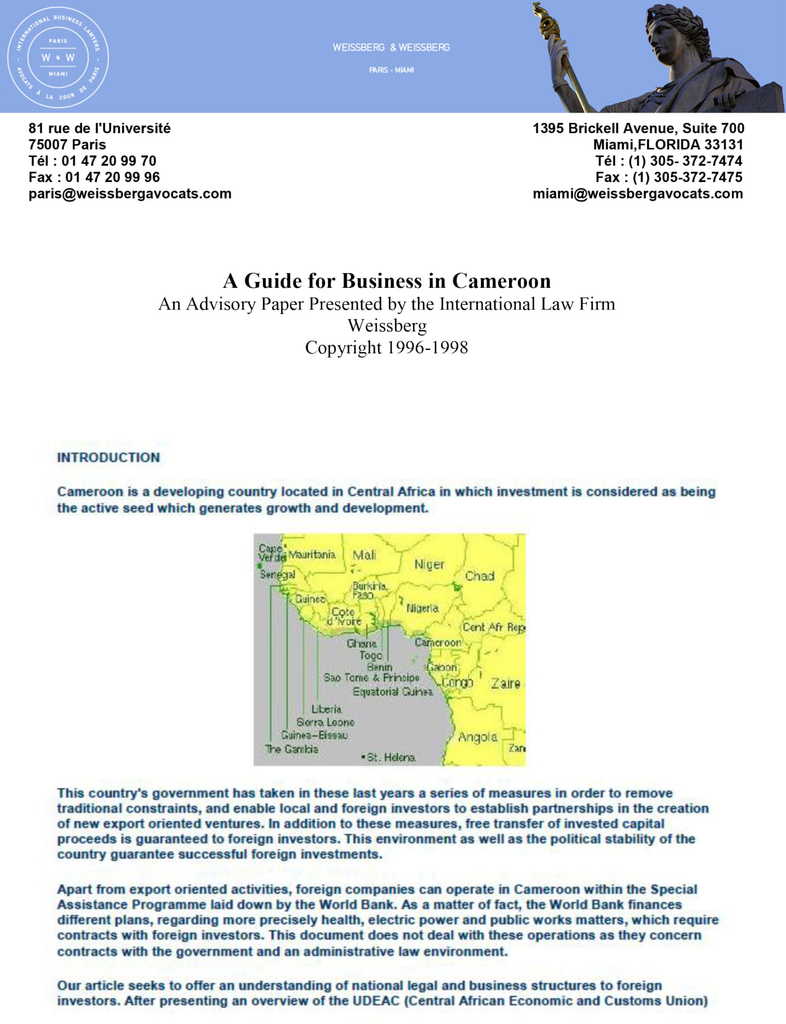
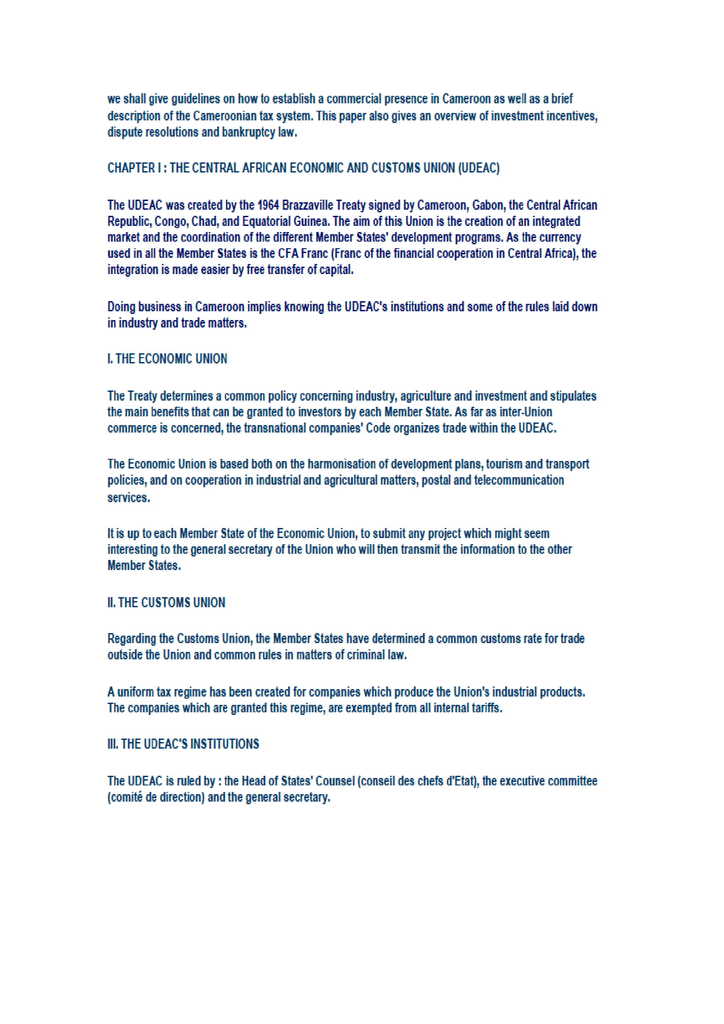
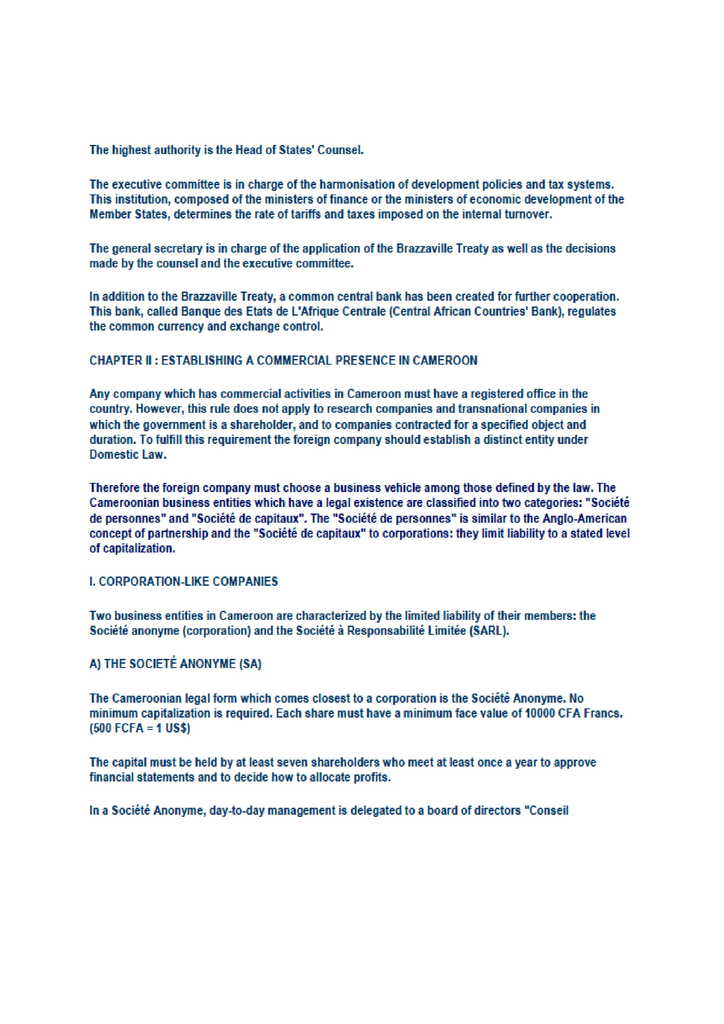
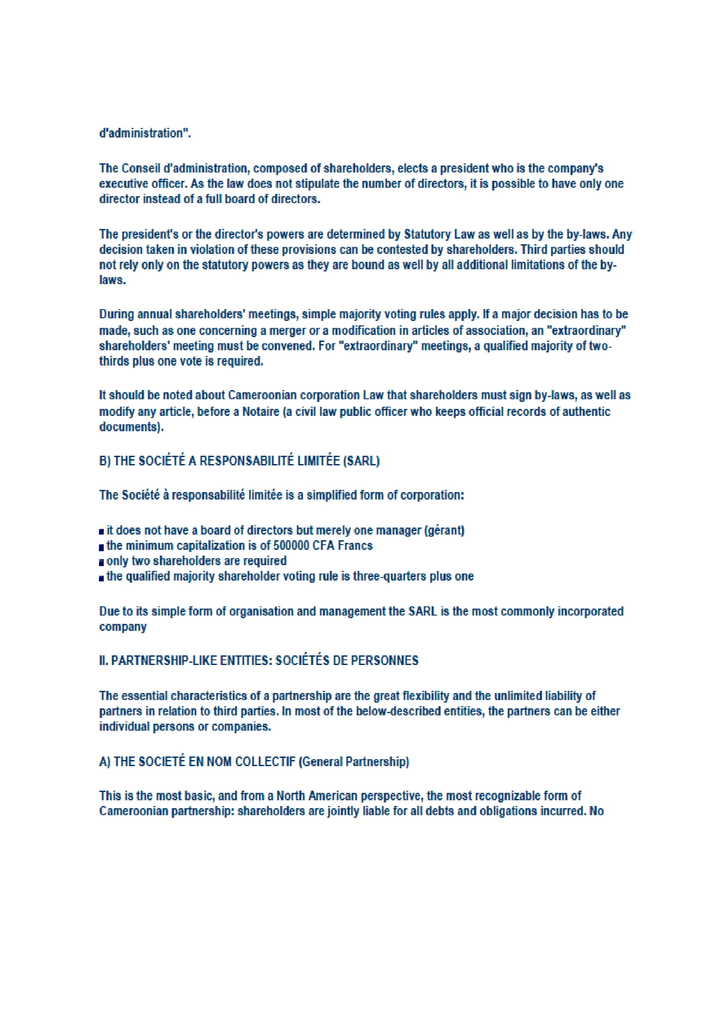
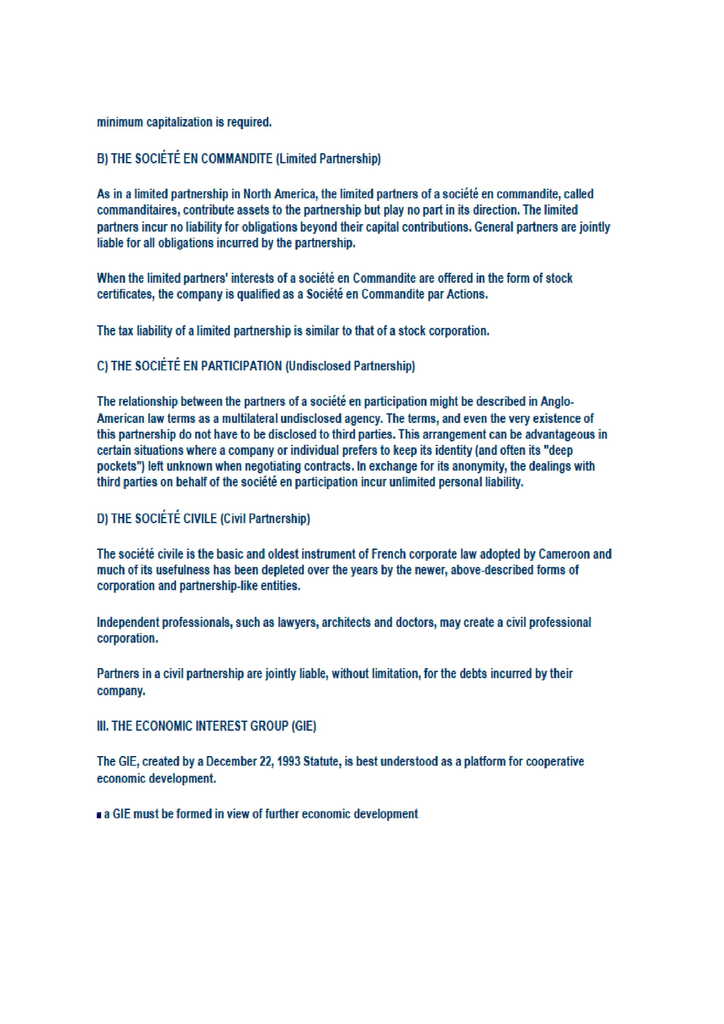
A guide for business in Cameroon: Cameroon is a developing country located in Central Africa in which investment is considered as being the active seed which generates growth and development.

A guide for business (1)
A guide for business (2)
A guide for business (3)
A guide for business (4)
A guide for business (5)
A guide for business (6)
A guide for business (7)
A guide for business (8)
A guide for business (9)
A guide for business (10)
A guide for business (11)
A guide for business (12)
A guide for business (13)
A guide for business (14)
A guide for business (15)
A guide for business (16)
A guide for business (17)


Cameroon investment codes (Fr)

Export legal and fiscal notebooks - Kenneth Weissberg (1996)

INTRODUCTION

At
Cameroon, the investment incentive is governed by Ordinance No. 90/007
of 8 November 1990 on the Investment Code and its implementing decree
nO 91/215 of May 2, 1991.

In 1994, this device
of encouragement has been substantially modified by ordinances n094 / 001,
002 and 003 of January 24, 1994 modifying certain provisions of the Code of
Investments within the framework of the tax and customs reform UDEAC.

Mon
the objectives of this tax and customs reform being to reduce
tax and tax exemptions in order to optimize the national tax yield,
the tax regimes granted under the Investment Code have been remitted
in question. Each regime had to be renegotiated with the Ministry of Development
Industrial and Commercial.

The law
of Finances for 1995/1996 confirmed this tax optimization policy by
reducing from 5 % to 0.5 % the reduction rate of the FOB value of exports
and by imposing certain basic products delivered to the Free Zones
Industrial.

However, this reform did
not abolished the Investment Code which still remains in force and
is still of some interest for any investor wishing to commit
economically in Cameroon.

It is however obvious
that now, with the liberalization of the Cameroonian economy and the reform
tax and customs, the Investment Code is of
mainly fiscal; economic, customs and commercial advantages
provided for by the Code falling almost under common law.

After presenting the scope of the Investment Code (I) and the approval procedure (II), the advantages common to all the schemes of the Investment Code (III) will be exposed.

The different regimes proposed by this Code will then be analyzed separately, with their respective specificities (IV). Finally, the status of Industrial Free Zones will be the subject of a separate study, taking into account its specific nature (V).

I - SCOPE OF APPLICATION OF THE INVESTMENT CODE

The following may apply for approval to one of the plans of the Investment Code:

Any Cameroonian or foreign natural or legal person, who creates or develops an economic activity oriented towards:

  • development of national natural resources,
  • the creation of new jobs,
  • production of competitive goods and services for internal consumption and export,
  • increased exports of manufactured goods,
  • transfer and adoption of appropriate technologies,
  • the protection of the environment,
  • improving the quality of life in rural and urban areas, and whose activity falls into one of these sectors:
  • agricultural production, processing of agricultural products, animal husbandry, fishing, logging combined with wood processing, storage and preservation of food products,
  • the transformation of hydrocarbons, the extraction and transformation of mineral resources, the manufacture of building and public works products, the transformation of materials leading to the production of a good,
  • construction of buildings and public works, ship repair, technological research and data management, hospital training and medical analysis laboratories, catering establishments integrated into a tourist complex or located in a site recognized as being of tourist interest, accommodation establishments likely to be subject to classification, approved tourism agencies, tailoring, maintenance of industrial equipment focused on the manufacture of spare parts, testing, analysis and control of raw materials, finished or semi-finished products used or produced by industry.

II - APPROVAL PROCEDURE

1. The Management Unit
of the Investment Code

To benefit from one of the plans offered by the Code of
Investments, the company must submit an application for approval to
the Investment Code Management Unit (CGCI), with the exception of the
regime of Industrial Free Zones which falls under the competence of the Office
National Industrial Free Zones (ONZFI), see below.

Investment Code Management Unit
Former ONCPB building. 3rd floor
PO Box 15438
DOUALA - CAMEROON
Tel (237) 42.59.46 / 43.31.11
Fax: (237) 43.30.07

The approval request files must include a list of documents, the details of which appear in article 39 of decree n091 / 215 of 2 May 1991.

2. Approval of the Code of
investments

The approval of a business
to one of the investment code regimes is granted by deed
regulatory.

The agreement specifies:

at. Regarding the business

  • the name and statutes of the beneficiary company,
  • the place of establishment of the company showing that it is not in a prohibited zone for the exercise of the action concerned,
  • the physical and financial investment program that the company offers,
  • the company's employment and professional training policy,
  • the objectives pursued in the investment program which must comply with the eligibility criteria corresponding to the regime granted.

b. Regarding administration:

  • the eligibility criteria for which approval is granted,
  • the regime and the advantages granted, distinguishing those relating to the installation phase from those relating to the operating phase; the transition from one phase to another being subject to control.

Any company approved for one of the schemes of
Investment Code must become operational (start of construction and
equipment) at the latest within two years from the date of
date of signature of the deed of approval. In default and in the absence of reason
valid, the act of approval becomes null and void.

III- ADVANTAGES COMMON TO ALL
REGIMES

The Investment Code has set up several advantages common to the different plans offered

A. Administrative advantage: the single window

The company
approved under one of the Investment Code regimes automatically benefits
centralized management of its authorization files necessary for its
activity, at the level of the Investment Code Management Unit.

All files are processed by the one-stop shop (obtaining the exemptions provided for by the texts, authorization to exercise certain activities, visas for national and foreign staff, residence permit, access to administrative documents in matters of importation, etc.)

B. Economic benefits

Any investment approved under one of the regimes of the Investment Code benefits from the guarantee of non-commercial risks of article 15 of the Treaty establishing the Multilateral Investment Guarantee Agency ratified by Cameroon.

In addition, finished or semi-finished products processed in Cameroon and exported by the approved company are exempt from exit duties and insurance and transport taxes.

Lastly, the enterprise which exports part or all of its industrial production can deduct from its income an amount that cannot be carried over equal to 0.5 % from the FOB value of exports of its finished or semi-finished processed products (before on July 1, 1995, the abatement rate was 5 %).

C. Customs benefits

The approved company
benefits from a common external customs rate including customs rates
moderate on equipment and raw materials intended for
companies.

It is important to specify that
the economic liberalization policy pursued by Cameroon these
recent years has relaxed the customs regulations in force, which
somewhat relativizes the advantages granted to companies in this area
approved.

IV - REGIMES PROPOSED BY THE INVESTMENT CODE OF THE
CAMEROON AND THEIR RESPECTIVE SPECIFICITIES

The Cameroon Investment Code includes several incentive schemes to invest:
  • For the creation of new companies, the Investment Code organized the basic regime and the regime for strategic enterprises
  • For the creation of exclusively export-oriented businesses, the Investment Code provides for the industrial free zone regime
  • For existing and operating companies, the Investment Code has set up the reinvestment regime.

The tax advantages granted under these various regimes take into account the progress of the investment project and distinguish the installation phase from the operation phase.

During the installation phase:

the company is required to provide a personal and joint bond or guarantee to guarantee the difference between the amount of duties and taxes payable under common law and that reduced by duties and taxes resulting from the approval. The installation phase may be extended by reasoned request presented to the Investment Code Management Unit, on reasoned request or force majeure.

It is now appropriate
to present the different investment regimes with their specificities
respective.

1. Basic scheme

with conditions
eligibility

To be able to benefit from the basic investment code regime, the project presented must:
- create jobs for Cameroonians (I per tranche of 10,000,000 F. CFA investment),
OR
- have an export activity of at least 25 % of turnover excluding taxes, OR
- use national natural resources other than energy and / or goods produced in Cameroon up to at least 25 % of the value of its inputs.

b) Advantages

In addition to the administrative, economic and customs advantages common to all the schemes of the Investment Code (see III), companies approved under the “basic” scheme benefit from the following tax advantages:

During the installation phase (three years)
  • exemption from registration fees for acts of capital increase,
  • exemption from registration fees for leases of buildings for exclusively professional use which are an integral part of the investment program selected (against 10 % under ordinary law),
  • exemption from transfer taxes on the acquisition of buildings, land and buildings essential for the implementation of the program (against 15 % under ordinary law),
  • exemption from registration fees for contracts for the supply of equipment and construction of buildings necessary for the implementation of the program, reduction of 50 % in corporate tax from the first tax year (the common law rate being 38.5 %),
  • exemption from the special tax for registration of business insurance contracts.
During the operating phase (renewable period of five years)
  • exemption from the minimum collection tax payable under corporate tax,
  • reduction of: - 50 % of the corporate tax for legal persons (the common rate being 38.5 %), - 50 % of the tax on industrial and commercial profits for sole proprietorships
  • reduction of 50 % of the proportional tax on income from movable capital (the common law rate for non-Cameroonian shareholders being 25 %),
  • possible carry-over to the results of the following five financial years of the deficit resulting from the allocation of depreciation normally recognized during the first three financial years,
  • deduction from the taxable income of the business of a non-reportable amount equal to 50 % of transport and utilities, when it settles in an area far from large urban centers.

2. Small and medium-sized enterprises scheme

a) Eligibility conditions

Companies must meet the following conditions to apply for approval to the “small and medium-sized enterprises” (SME) plans:
- create permanent jobs for Cameroonians (1 job for every 5,000,000 FCFA of investment),
OR
- have a level of investment less than or equal to 1.5 billion CFA francs,
AND,
- have a stake in the capital of the Cameroonian natural person company or of Cameroonian company up to at least 35 % of this capital.

Decree n091 / 215 of May 2, 1991 specifies that it is an effective participation in the capital and excludes the use of counter letter.

b) Advantages

Notwithstanding the administrative, economic and customs advantages already set out in Chapter III, economic operators approved under the "small and medium-sized enterprises" regime benefit from the following tax advantages:

- During the installation phase (three years)
During the installation phase, companies approved under the “small and medium-sized enterprises” regime enjoy the same tax advantages as those granted to enterprises under the “basic” regime.

- During the operating phase (non-renewable period of seven years)
In the operating phase, a company approved under the “SME” scheme benefits from the same tax advantages as under the “basic” scheme, with the additional possibility of deducting from its taxable income a non-reportable amount equal to 25 % of the wage bill paid to employees of Cameroonian nationality during the financial year in question.

3. Regime for strategic enterprises

Conditions of eligibility

To be approved for the “strategic business” plan, you must:
- be declared strategic in the Industrialization Master Plan, AND,
- have an export activity equal to at least 50 % of its annual turnover excluding taxes,
OR,
- use national natural resources, excluding energy resources and / or goods or services produced in Cameroon up to at least 50 % of the value of its inputs,
OR,
- create permanent jobs for Cameroonians (1 job for every 20,000,000 F. CFA investment).

If these conditions are met by the company, an agreement with the Cameroonian State may be signed, specifying the reciprocal commitments of the parties.

Benefits

In addition to the administrative, economic and customs advantages set out above in Chapter III and IV, economic operators approved under the "strategic enterprises" regime benefit from the following tax advantages

- During the installation phase (three years)
During the installation phase, the tax advantages granted under the “strategic enterprises” regime are identical to those granted under the “basic” regime.

- During the operating phase (non-renewable period of twelve years)
In the operating phase, the company approved under the "strategic enterprises" regime benefits from the same tax advantages as in the "basic" regime, with the additional possibility of deducting from its taxable income a non-reportable amount equal to 25 % of the payroll paid to employees of Cameroonian nationality during the financial year in question.

4. Reinvestment scheme

Conditions of eligibility

If an enterprise is governed by ordinary law or by a special scheme which has expired, it may apply for approval of the "reinvestment" scheme provided that its program:
- has been approved under the reinvestment scheme of the General Tax Code,
AND,
- anticipates an increase in productivity and an increase in production of at least 20 % compared to the situation at the time of filing of its application for approval,
OR,
- enables it to offer a higher category of services than that which it was capable of providing at the time of filing its request for approval.

Benefits

In addition to the administrative, economic and customs advantages set out above
(page 689), economic operators approved under the "
reinvestment ”benefit from certain tax advantages which,
unlike the diets previously studied, do not change over time.

For a period of three years from the date of granting of approval, the company approved under the "reinvestment" scheme benefits from:
- a reduction in corporate tax or proportional tax on the income of natural persons on the basis of 50 % of reinvestments accepted,
- exemption from registration fees for acts of capital increase,
- an exemption from the registration fees for leases of buildings for exclusively professional use forming an integral part of the investment program adopted by the company.

V - REGIME OF THE INDUSTRIAL FREE ZONE

Ordinance n0 90/001 of January 29, 1990 created the Zone regime
Industrial Free and Industrial Franc Point in Cameroon and Order No. 5
IIMINDIC / IGI of December 28, 1990 fixed the terms of application.

Applications for the granting of industrial free zone status or
Point Franc Industriel must be submitted to the National Office of Zones
Industrial freeholds (ONZFI). The Minister in charge of Industrial Development
issues the decree granting the status of Industrial Free Zone which decree
is notified to the candidate by ONZFI.

National Office for Industrial Free Zones
PO Box 925
DOUALA - CAMEROON
Tel: (237) 43.34.44
Fax: (237) 43.33.17
terms

The conditions required to be able to benefit from the status of Industrial Free Zone or Industrial Free Point are as follows:

  • use at the latest at the end of the 5th year, at least 80 % of Cameroonian staff and ensure their continuous professional training,
  • produce goods or services intended exclusively for export or to markets outside Cameroon. (Note: A company in the Industrial Free Zone may export, exceptionally, part of its production to the national customs territory, under conditions set by the Ministry of Industry.)
  • not to produce harmful effects for the environment,
  • not to be in possession, without prior authorization, of products whose entry and storage are prohibited in an industrial free zone,
  • not to carry out activities outside the Industrial Free Zone for which approval is sought,
  • offer all the facilities and grant all support to the agents of the Cameroonian security forces who ensure the police and the maintenance of order in the Industrial Free Zones,
  • organize clean security services in industrial free zones. (Note: The 1995/1996 Finance Law excluded forest exploitation companies from the status of Zone Franche Industrielle. Wood processing industries are however still eligible for this scheme).
Benefits
* Commercial advantages

The General Exchange Program (PGE) in
force in Cameroon does not apply to Industrial Free Zones. To this
title, imports and exports are neither subject to a
license, authorization or quota limitation.

It is important to remember that the common law of
Cameroonian customs regulations have been relaxed in recent years
within the framework of the liberalization of the economy and the reform
customs fiscal; which somewhat relativizes the advantages granted in this
domain for companies in Industrial Free Zones.

The imports and exports of the Industrial Free Zones are
subject to the formality of prior declaration for statistical purposes
for ONZFI and inspection and control by customs services.

No price control or
profit margin does not apply to the products and services of
Industrial free zones.

Fiscal advantages

Companies approved as Zone Franche Industrielle or Point Franc Industrielle benefit from significant tax advantages:
- total exemption during the first ten years from direct and / or indirect taxes and charges in force or to be created as well as registration and stamp duties of any kind whatsoever,
- from the 11th year of operation, even exemption, with the exception of the tax on industrial and commercial profits (BIC) to which they are subject to the overall rate of 15 %.

The tax profit determined in application of the provisions of the General Tax Code is obtained after allocation:

  • an amount equal to 25 % of the payroll paid to employees of Cameroonian nationality during the financial year,
  • an amount equal to 25 % of the capital expenditure for the financial year. In the event of a change in the BIC tax base rules, the new provisions only apply to approved companies if they are more favorable to them.
  • the deficits suffered during the exemption period are considered as expenses for the following years and deducted from the profits made during said years, without limitation of the delay period,
  • no obligation to reinvest the special fixed asset revaluation reserve prescribed by the laws and regulations in force,
  • exemption from transfer tax for any sale of real estate within the ZFI,
  • exemption from any tax on the transfer of currency for any purchase or sale of currency by a ZFI company.
  • Customs benefits

All exports from a
Industrial Free Zone are exempt from all customs duties and taxes and
all other direct and / or indirect taxes, duties and taxes, current and
future.

With regard to imports, these
were exempt, like exports, from all duties and taxes
until June 30, 1995.

Since July 1, 1995 (Finance law
1995/1996) deliveries to industrial free zones of coffee, cocoa,
medicinal plants, wood logs, rubber, sugar, palm oil and
bananas are assimilated to exports and, therefore, subject to
exit or export levy applicable to these products.

CONCLUSION

At the end of this
analytical presentation of the investment incentives in force at
Cameroon, it is necessary to note that these are part of a
essentially fiscal perspective since the liberalization policy of
the economy and the measures taken by the Cameroonian government within the
of the tax and customs reform UDEAC.

In order to give back to the Code
of Cameroonian Investments the means to enable it to ensure
fully its appealing vocation to national investors and
foreigners, it seems necessary to review its provisions.

According to the Management Unit
of the Investment Code, preparatory work has already been launched in
that Sens. Some even mention a regional investment code.


United States: the anti-dumping procedure (Fr)

1993 Export Legal and Tax Notebooks

The anti-dumping law constitutes an important element of the legal arsenal available to American industrial companies, to protect themselves from foreign competition which sells on the American market at a price considered as not reflecting the fair value of the product (" prices below fair value ”).

The law provides that an "anti-dumping" tax will be added to normal customs duties, if two conditions are met:
1. that the goods are sold in the United States below their 'fair value'
2. that an industry in the United States is suffering, or is threatened with, real injury as a result of its imports.

Dumping cases therefore have two aspects:
A determination by the Department of Commerce (hereinafter DOC) as to whether
sales take place in the United States below the "fair value" of the product and a
determination of the existence of damage suffered by the complainant by the Commission of
Commerce International (hereinafter ITC).

A) DETERMINING THE DOC ON THE EXISTENCE OF SALES BELOW THE FAIR VALUE OF THE PRODUCT: "SALES AT LESS THAN FAIR VALUE"

The law defines 'fair value' as being, in order of preference:
1. the selling price on the producer's national market, or goods,
2. the selling price on third country markets, or goods,
3. the reconstituted value.
If there are sufficient sales in the home market, the DOC will not address the
sales in third countries. On the other hand, if sales in the home market or in countries
third parties prove to be below the cost of production, the DOC will use the reconstructed value
which is equal to the cost of production plus a minimum of 10 % for overheads and 8 %
of profit.

In general, for sales in the United States, the DOC takes into account the price made by
the exporter to the American importer, There are however special rules when the
sales are made by the exporter to US affiliates.

To establish its basis for comparing sales prices, DOC details all the elements of the
price such as transport, insurance, packaging, etc., in order to obtain an ex
facto for each market consistently.

To this end, the DOC obtains the information it needs by sending a
detailed questionnaire to the main exporters in the designated country. Essentially, the
exporters must describe all their sales in the United States and overseas markets
appointed over a period of time which is generally six months. This list should
be established invoice by invoice and each item of each invoice is individualized on the list.

The exporter is required to submit this information in hard copy and on a
IT support, according to the software model established by DOC.

When DOC requires cost of production information, the exporter must
give details of its costs for each type or model of product under investigation.

In addition, the exporter must allow members of a DOC Board of Inquiry to
visit their offices and factories to verify the accuracy of information
communicated.

If a foreign company does not respond to the DOC questionnaire, or if a response cannot be
not be verified, the DOC will then use the criterion of the best available information
("Best information available") to calculate the dumping margin. This better information
available almost always corresponds to the figures alleged in the complaint.

Knowing this, the complaining companies always report the highest credible margin,
so that if the foreign exporter does not cooperate, the customs penalty will be very high.

B) THE DETERMINATION OF INJURY BY THE ITC (INTERNATIONAL TRADE COMMISSION)

The ITC is an administrative agency separate from DOC, which is responsible for deciding whether a
American industry is affected by the discriminatory practice.

The law defines material damage as damage which is not negligible.

To establish the existence of material damage, the Commission analyzes the volume of
imports, the effect of these imports on prices, lost sales, market share,
profits and productivity of national companies, profitability, capacity of use,
employment, stocks ...

If a complaint is filed against two or more countries, the Commission will determine the volume and
the effect of these imports cumulatively.

C) THE PROCEDURE

The law and regulations provide for very strict and very short procedures and deadlines for
each phase of the procedure.

It is therefore essential that the defendant company prepare its answers as quickly as possible.
and as completely as possible, because failure to meet deadlines can be fatal.

When a dumping proceeding is initiated, the investigation covers specific products in
from a specific country. The national character of the dumping proceeding is
consequence that all producers and exporters in this country are affected by this
procedure, whether or not they are named in the complaint. If a dumping decision is
finally made, it will apply to all companies in the country concerned, whether they have or
not participated in the information.

1. Opening of information by DOC

Within 20 days of filing the complaint, the DOC must decide whether to
opening of information. If so, the information is opened on the 20th day.

2. Prior determination of ITC

The ITC must complete its preliminary injury determination within 45 days of
follow the filing of the complaint. In order to meet this deadline, the Commission sets the first date
public hearing practically immediately after the opening of the information, in
general on the 21st or 22nd day after filing the complaint.

Due to this very short delay, the foreign industry must decide, before the information is
be open, if it intends to participate in this hearing. If so, she must take
immediately counsel, gather the evidence and prepare his defense.

Indeed, if it waits for the information to be effectively opened, it will not have the
time needed to prepare for this hearing.

The Commission having to examine the injury suffered by the American industry, it is the market
of the United States which will be the object of its main attention. Companies that import and sell
product in the US market can be of great help in this regard as they
know the market much better than the foreign producer. Their participation as well
that that of their client is therefore very important at this stage of the procedure.

Within 45 days of filing the complaint, the Commission must decide whether there is a
reasonable indication of material damage, based on the best information available to the
Commission at that time. If the ITC decides in the affirmative then, the investigation procedure
of DOC begins. In the event that the Commission's preliminary determination is
negative, the case is closed.

3. Preliminary determination of the DOC

Within 160 days of filing the complaint, if the ITC has issued an affirmative opinion on the
prejudice, the DOC must make a “preliminary determination” as to whether the
products are sold below their "fair value".

As soon as it receives the green light from the ITC, the DOC sends a questionnaire to all the principal
producers in the country under investigation. Each producer has 30 days to respond and can,
in general, obtain an additional 15 days. These questionnaires require a
considerable amount of general information about each company and further request
that a detailed list be drawn up of all sales made one by one in the United States and
in the foreign market during the period under investigation. It is usually
a period that covers the 5 months preceding the filing of the complaint. Responses to
questionnaire must be given on a computer diskette in the format proposed by
the DOC. Most of the time, the computerized responses to this sales questionnaire will
several hundred pages long and will have several thousand lines of
information.

In a case concerning the cost of production and the reconstructed value, the questionnaire
DOC will also request information regarding the cost of production of each
sample of product model or type under investigation. This information is
usually required in chronological order for a full year, divided into
quarter, plus information for the period running up to the month in which the
complaint. For example, If a complaint is filed in July 1987, information on the
costs will likely be required for each quarter of 1986 plus the first two
quarters of 1987.

If the DOC receives the responses to the questionnaires in a timely manner, it will base its determination
preliminary on these answers. Otherwise, it will use its "best source of information
available ”.

4. Effects of the DOC's Prior Determination

If this prior determination is affirmative and the DOC considers that there are margins
of dumping, the determination will say what percentage of the US price is exceeded by the
price of the foreign product.

This preliminary determination has two consequences:
a) DOC orders the suspension of liquidation of any pending imports for
products subject to this determination and require importers to deposit an amount
equal to the said margin for any new importation.
b) ITC begins its final injury investigation.

5. Final determination of the DOC

Within 75 days of its preliminary determination, DOC must issue its decision
definitive, determining whether the sales took place below fair value.

Before making this final decision, the DOC teams will visit the offices or factories of all the companies that replied to the questionnaires to verify the accuracy of their responses. Any response that has not been verified will be rejected and the DOC will generally rely on the margins alleged in the complaint as the best source of information available.

If the final determination is affirmative, the DOC will maintain the stay of the liquidation
rights and will modify the margin initially estimated, in accordance with its final result.

If DOC's final determination is negative (zero margin), the investigation will be terminated and the
sums deposited will be refunded. A negative final determination is a victory
for the country of export. However, it happens that one or more countries subject to investigations
receive a negative final decision from DOC and others receive an affirmative decision. In this
case, the first companies are then no longer concerned by the case which continues against the
other.

It is also important to note that DOC does not have an obligation to investigate and issue its
questionnaire only for companies which represent a quantity of substantial exports for the
product concerned in each country involved.

According to DOC's interpretation, this applies to companies responsible for at least 60 % of
these exports. If a company does not receive a questionnaire, it will however be subject to
a dumping rate corresponding to the average of the rates applied against the companies which have
received the questionnaire.

Accordingly, it is important to determine in advance what the particular margin of a
company is likely to be, and, If low or non-existent, to ensure that the company in
question receives a questionnaire from DOC. This will allow this company to get its own
rate (hopefully zero) and thus protect against the consequences of the average rate
which is likely to be much superior to that which would concern it. If the current rate of this company is
equal to zero, it will be exempt from the consequences of the subsequent dumping decision.

6. Retroactive application of dumping rates

In addition to the above, it is possible that dumping duties may be imposed retroactively up to 90 days before the date of the decision ordering the suspension of the assessment of the duties. This happens If the DOC determines that there are "critical circumstances". Such a decision requires:
I) - a history of dumping of this goods in the United States or elsewhere or that the importer knew that the goods were sold below their fair value and
II) - that there was a massive importation of this commodity during a short period. If these two conditions are met. dumping duties can be imposed retroactively.

7. Final determination of ITC

If the DOC issues a final determination of dumping, the ITC will have to issue a
final determination of damage. The timeframes for this depend on what the
DOC's prior determination was affirmative or negative. In this decision
final, the Commission decides whether the domestic industry has, in fact, suffered material injury
or If threatened by material injury as a result of the dumped imports.

If the ITC's final determination is affirmative, USDOC will issue an order of
dumping. From that moment the importer will have to enter the estimated amount of duty
in the amount of the margin when the goods will be imported.

These rights are then subject to liquidation during the following annual verifications, which
can take place at the request of an importer, exporter or producer
national.

If the ITC's final determination is negative (no prejudice). The case is closed. A
such a decision clearly constitutes a complete victory for the exporting party.

CONCLUSION

Usually, a dumping case is completed within 1 month from the filing of
the complaint. The time available to the foreign party to submit the required information
is very short just a few days in the initial phase to prepare for the hearing of the
Commission and only 30 to 45 days to respond to the DOC questionnaire.

Therefore, it is in the interest of the country under investigation to begin
preparing his defense as soon as possible. This means that decisions regarding the
how to proceed should be taken soon after the complaint is filed and well before
that the information be open. This advance preparation concerns both the audience of
ITC that the preparation of the information necessary for the response to the
DOC. Companies that will be able to ensure 4 to 6 weeks of preparation
more by preparing their answers in advance will have the best chance of success
in the final issue.

On the other hand, for the reasons explained above, each exporter has an interest in protecting his
own position by taking action as soon as possible after a complaint has been
filed against a company in his country, or even before, if he is informed that such a complaint
is about to be filed.